
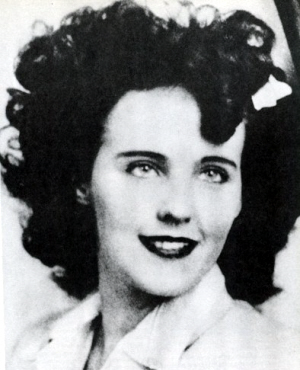
“The Black Dahlia” was a nickname given to Elizabeth Short, an American woman who was the victim of a gruesome and much-publicized murder.
Elizabeth Short was born in Boston, Massachusetts on July 29, 1924; she grew up and lived in Medford. She was the third of five daughters of Cleo Short and Phoebe Mae Sawyer. Her father built miniature golf courses until the 1929 stock market crash, in which he lost much of the family’s assets. In 1930, he parked his car on a bridge and vanished, leading some to believe he had committed suicide. Later, Cleo decided he made a mistake, contacted Phoebe and apologized for what he had done. He asked to come home. Phoebe, who had faced bankruptcy, worked part-time jobs, stood in lines to get public assistance and raised the five children alone, wanted no part of Cleo and refused to reconcile. Short’s mother moved the family to a small apartment in Medford and found work as a bookkeeper.
Despite her parents’ difficulties, Elizabeth continued to correspond with her father. She was growing up to be an attractive young girl and like many teenagers, enjoyed going to the movies. At the age of 16 Short was troubled by asthma and bronchitis, she sent to live for the winter in Miami, Florida. She spent the next three years living there during the cold months and in Medford the remainder of the year. At age 19, Elizabeth’s father, who was working nearby at Mare Island Naval Shipyard on San Francisco Bay, sent her money to join him in Vallejo, California. They moved to Los Angeles in early 1943 but the reunion was short lived and Cleo soon grew tired of Elizabeth’s lifestyle of sleeping during the day and going out on dates until late at night. An altercation resulted in her leaving there and finding work in the post exchange at Camp Cooke (now Vandenberg Air Force Base), near Lompoc, California.

Short next moved to Santa Barbara, where she was arrested on September 23, 1943, for under-age drinking. Following her arrest, she was sent back to Medford by the juvenile authorities in Santa Barbara. Short then returned to Florida to live, with occasional visits to Massachusetts. In Florida, Short met Major Matthew Michael Gordon, Jr., a decorated United States Army Air Force officer who was assigned to the 2nd Air Commando Group and in training for deployment to China Burma India Theater of Operations. Short told friends that Gordon wrote her a letter from India proposing marriage while he was recovering from injuries sustained from an aeroplane crash. She accepted his proposal, but Gordon died in a second air-plane crash on August 10, 1945, before he could return to the United States. She later exaggerated this story, saying that they were married and had a child who died. Although Gordon’s friends in the air command confirmed that Gordon and Short were engaged, his family denied any connection after Short’s murder. Elizabeth Short returned to Los Angeles in July 1946 to visit Army Air Force Lieutenant Joseph Gordon Fickling, an old boyfriend she had met in Florida during the war. At the time Short returned to Los Angeles, Fickling was stationed at NARB, Long Beach. For the six months prior to her death, Short remained in southern California, mainly in the Los Angeles area.
Friends described Elizabeth as being soft spoken, courteous, a non-drinker, or smoker, but somewhat of a loafer. Her habit of sleeping late in the day and staying out at night continued to be her lifestyle. She was pretty, enjoyed dressing stylishly and turned heads because of her pale skin contrasting against her dark hair and her translucent blue-green eyes. She wrote to her mother weekly, insuring her that her life was going well. Some speculate that the letters were Elizabeth’s attempt to keep her mother from worrying. Those around her know it that over the next few months she moved often, was well liked, but illusive and not well known. During October and November of 1946, she lived in the home of Mark Hansen, owner of the Florentine Gardens. The Florentine Gardens had a reputation as being a rather shoddy strip joint in Hollywood. According to reports, Hansen was said to have various attractive women rooming together at his home, which was located behind club. Elizabeth’s last known address in Hollywood was the Chancellor Apartments at 1842 N. Cherokee, where she and four other girls roomed together.

In December, Elizabeth boarded a bus and left Hollywood for San Diego. She met Dorothy French, who felt sorry for her and offered her a place to stay. She stayed with the French family until January when she was finally asked to leave. Robert Manley was 25 years old and married, working as a salesman. According to reports, Manley first met Elizabeth in San Diego and offered her a ride to the French house where she was staying. When she was asked to leave, it was Manley who came and drove her back to the Biltmore hotel in down town Los Angeles where she was supposed to be meeting her sister. According to Manley, she was planning to go live with her sister Berkeley. Manley walked Elizabeth to the hotel lobby where he left her at around 6:30 p.m. and drove back to his home San Diego. Where Elizabeth Short went after saying goodbye to Manley is unknown.
The body of Elizabeth Short was found in the Leimert Park district of Los Angeles on January 15, 1947. Her remains had been left on a vacant lot on the west side of South Norton Avenue midway between Coliseum Street and West 39th Street. The body was discovered by local resident Betty Bersinger, who was walking with her three-year-old daughter around 10 a.m.; Bersinger initially mistook the body for a discarded store mannequin. Upon realizing it was a corpse, Bersinger rushed to a nearby house where she phoned the police. Short’s severely mutilated body was severed at the waist and completely drained of blood. Her face had been slashed from the corners of her mouth toward her ears, creating an effect called ‘The Glasgow Smile’. Short also had multiple cuts on her thigh and breasts, where entire portions of flesh had been removed. The body had been washed and cleaned and had been “posed” with her hands over her head, her elbows bent at right angles, and her legs spread, she was 22. Near the body detectives found a cement sack which contained droplets of watery blood, as well as a heel print on the ground amidst tire tracks.
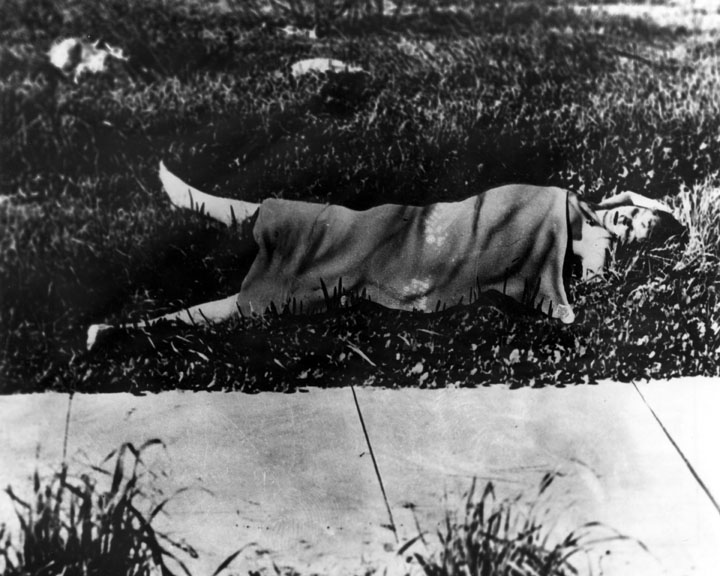
The autopsy stated that Short was 5 feet 5 inches (1.65m) tall, weighed 115 pounds (52kg), and had light blue eyes, brown hair, and badly decayed teeth. There were ligature marks on her ankles, wrists, and neck. Although the skull was not fractured, Short had bruising on the front and right side of her scalp with a small amount of bleeding in the subarachnoid space on the right side, consistent with blows to the head. The cause of death was hemorrhage from the lacerations to the face and shock due to blows on the head and face.
William Randolph Hearst’s papers, the Los Angeles Herald-Express and the Los Angeles Examiner, sensationalized the case: The black tailored suit Short was last seen wearing became “a tight skirt and a sheer blouse” and Elizabeth Short became the “Black Dahlia,” an “adventuress” who “prowled Hollywood Boulevard.” As time passed, the media coverage became more outrageous, with claims that her lifestyle had “made her victim material.”


Due to the notoriety of the case, more than 50 men and women have confessed to the murder, and police are swamped with tips every time a newspaper mentions the case or a book or movie about it is released. Sergeant John P. St. John, a detective who worked the case until his retirement, stated:
Gerry Ramlow, a Los Angeles Daily News reporter, later stated:
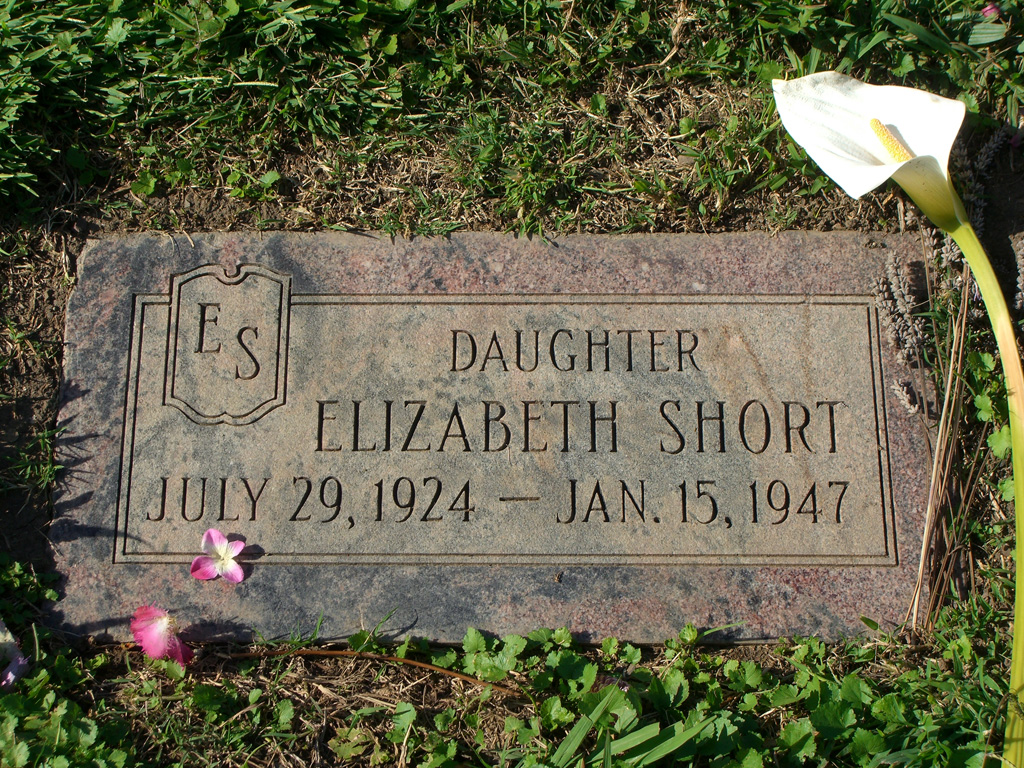

In his 2003 book “Black Dahlia Avenger”, Steve Hodel first made the claim that his father, a doctor, was responsible for the murder. George Hodel had been a suspect in the original case and investigators had even planted a bug in the house to listen for incriminating admissions. But before authorities brought charges, Dr. Hodel abruptly abandoned his family and relocated to Asia. He died in 1991. Steve Hodel believes his father killed the Black Dahlia at the family’s then home, the distinctive ‘Sowden House’ in Hollywood, which is largely unchanged and looks the same as it did at the time of the murder.

Hodel was also able to establish that he and his siblings had been away with their mother at that time. When the opportunity arose for Hodel to return to his childhood home, he jumped at the chance after producers of the SyFy Channel’s “Ghost Hunters” program arranged it with the current owners. Last November Hodel, together with retired police Sgt. Paul Dostie of Mammoth Lakes and Buster, a Labrador retriever trained to detect the unique smell of human composition, visited the property. Once let loose, Buster quickly established four locations in the basement where he could pick up a faint trace of human remains.
The basement had never been finished and since the floor was still dirt, soil samples were taken. Hodel is awaiting the results of those samples. To this date no results have been published.

 Raz's Midnight Macabre