
The living dead have taken over the world, and the last humans live in a walled city to protect themselves as they come to grips with the situation.
It took Romero twenty years to make this film, twenty years!
Unfortunately, well for me anyway, it just didn’t hit the mark. I know a few fans who weren’t fans of this either but I’ve also met people that say this is their favourite. Personally I don’t see it but whilst I’m not a fan there were some aspects I liked about it.
I did enjoy the idea of this film. The dystopian setting with the usual Romero social commentary, great casting with the likes of Dennis Hopper and John Leguizamo and more gore. It should have been great and on paper it is, but something went wrong somewhere.

The story is quite a muddled one that has quite a few plot holes and the characters aren’t the most likable, which is really strange for a Romero film. I also didn’t understand the use of CGI (it was distractingly bad), especiall when you have Savini and Nicotero on board.
I also wasn’t a fan of the ‘evolving zombies’ plot, I understood the use of ‘Bub’ in DOTD but this one for me took it too far. Gone were the rotting corpses looking for something to eat, now they’re organised and pissed off, intelligent zombies did nothing for me.

For me this was a lackluster return for Romero but admittedly it was good to see him back among the undead nonetheless.
Miscellaneous facts about the film:
Partly based on the original, much longer script for Day of the Dead (1985).
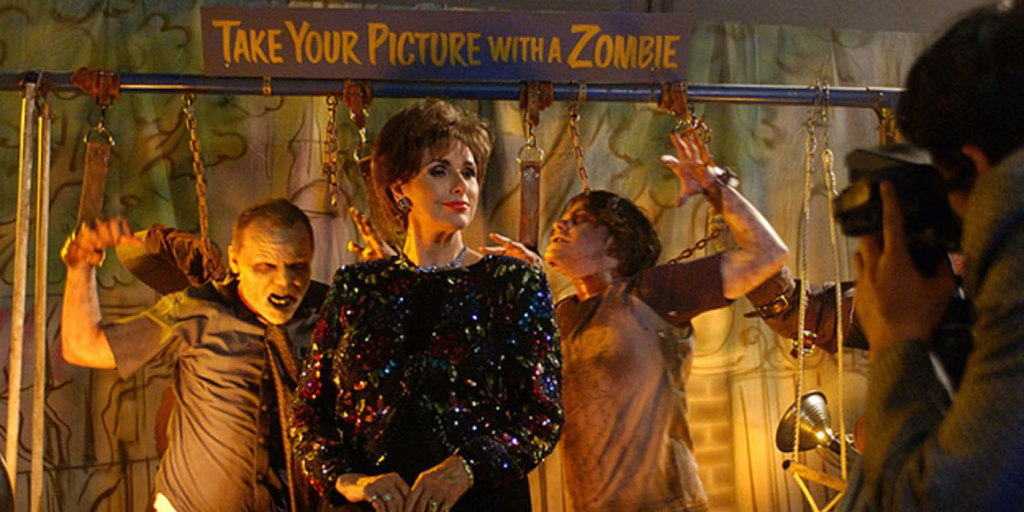
George A. Romero was so impressed with Simon Pegg and Edgar Wright’s Shaun of the Dead (2004), that he asked them to appear in this, the fourth part of his “Dead” series, and they appear as the photo-booth zombies in the carnival and barroom sequence. They also feature prominently in the artwork for the Unrated Director’s Cut.
At the beginning of the movie, if you listen carefully to the tuba and tambourine zombies in the town bandstand, they are playing notes from “The Gonk”, the mall music from George A. Romero’s Dawn of the Dead (1978).
This movie’s Pittsburgh premiere was at the Byham Theatre, which used to be called the Fulton Theatre. This theater, when it was still the Fulton, was the same theater where Night of the Living Dead (1968) premiered in 1968.
The zombie of Tom Savini’s biker character, who was killed in Dawn of the Dead (1978), can be seen in one of the scenes.
George A. Romero’s daughter appears in the film. She is the soldier who shoots the zombie on the electrified fence.
In later interviews, George A. Romero implied that Dennis Hopper’s cigar budget cost more than his original Night of the Living Dead (1968).
An amputee played the legless zombie climbing the back of the Dead Reckoning. His name is David Campbell, and was also in Dawn of the Dead (2004) as the “Squished Zombie”.
This is the first film of George A. Romero’s “Living Dead” series which uses digital effects.
George A. Romero intended to make this film in his hometown of Pittsburgh, Pennsylvania. The story is set there, and it’s where he made his other zombie films. However, the producers insisted on filming in Toronto, Ontario, in order to take advantage of Canadian tax incentives, creating a setting that retains Pittsburgh’s geography, with physical locations of Toronto that have been altered.
Simon Baker took on his role in the film because he’d never appeared in a horror movie before and because he wanted to work with George A. Romero.
The view of the zombies rising from out of the river is an homage to the classic scene from Herk Harvey’s Carnival of Souls (1962), where the dead rise out of the Great Salt Lake before the dance sequence.
The most expensive of George A. Romero’s zombie movies.
The opening credits includes a montage detailing the zombie outbreak leading up to the events of this film, with black and white footage and radio broadcasts depicting the infection’s spread over the Earth. Some of the images come from George A. Romero’s Night of the Living Dead (1968) portraying the beginning of the outbreak. Romero wanted to use more footage from the other two films of the series up to that point, Dawn of the Dead (1978), and Day of the Dead (1985), but was unable to due to complications with the rights of those films. This is because each of his zombie films has been produced by a different studio. This can also be seen in the credits for Tom Savini’s cameo in the film. He is the undead version of the character he portrayed in Dawn of the Dead (1978), named “Blades”, but he could only be credited in this film as “Machete Zombie”.
Dennis Hopper based his performance as Kaufman on Donald Rumsfeld.
Much like Bub in Day of the Dead (1985), Big Daddy is never seen attacking a living human for food, and thus only kills the main human antagonist as an act of revenge. Bub did, however, consume the butcherd flesh and organs of the recently deceased Pvt. Johnson and Pvt. Miller given to him by Dr. Logan, implying he has not entirely lost his taste for human flesh.
The success of Zack Snyder’s remake of Dawn of the Dead (2004) led Universal to greenlight a fourth instalment of George A. Romero’s zombie series.
A non-union zombie would make nine dollars per hour Canadian, while a union zombie, for a minimum of eight hours, would make one hundred fifty-eight dollars Canadian.
There were four titles before “Land of the Dead” was chosen: “Dead City”, “Dead Reckoning”, “Twilight of the Dead”, and “Night of the Living Dead: Dead Reckoning”.
This is the first film in the series to be released with an MPAA rating.
Susan Wloszczyna, a reporter for USA Today, appeared as one of the zombies. She was there interviewing her fellow zombies, as well as the director. She spent nearly an hour and forty-five minutes in the make-up chair.
Bub, the zombie from Day of the Dead (1985), makes appearance. At the beginning of the movie when Cholo is taking the box of champagne from the fridge, its Bub that lunges at him. You can see his collar still intact from the original DOTD.
“Fiddler’s Green” is a song about the place where cavalrymen go when they die, located “Halfway down the trail to Hell”, and, in the end, advocates suicide by pistol when death is certain, and the hostiles are closing in. “Fiddler’s Green” possibly originated in England at least to the nineteenth century, and is still sung today. The song speaks of a place where fisherman go, if they don’t go to Hell. It found its way to the U.S. with the help of Cornish settlers. The fictional place of Fiddler’s Green is also the final resting place for pirates.
Movie theaters showing this film in the U.S. were given a replacement track for the typical music and commercials usually heard playing over still images of advertisements before a movie starts. This track consisted of sound bites of music and lines from Night of the Living Dead (1968), and Day of the Dead (1985), along with an advertisement for then upcoming airings of Dawn of the Dead (1978) on a pay-per-view network.
The first trailer for this film used clips not just from Night of the Living Dead (1968) but also from Dawn of the Dead (1978) and Day of the Dead (1985). Although Night is in the public domain, both Dawn and Day are owned by separate companies, neither of which had given permission for the use of footage in the trailer. To avoid legal troubles, this trailer was quickly pulled from distribution, and hasn’t been officially shown since.
John Leguizamo’s character’s name “Cholo” is a pejorative word used in South American Spanish to refer to Ecuadorians, Peruvians, and Bolivians, who have strong Indian features.
The first and, to date, only George A. Romero zombie film to use the 2.35:1 aspect ratio. The other films used standard 4:3 or Flat Ratios. Night of the Living Dead (1968) (1.33:1), Dawn of the Dead (1978) (1.85:1), Day of the Dead (1985) (1.85:1), and Diary of the Dead (2007) (16:9 a.k.a. 1.78:1).
One working title for the film was “Dead Reckoning”, but it was changed to avoid confusion with the Humphrey Bogart film of the same name.
Dennis Hopper and Robert Joy previously appeared in Waterworld (1995). In that movie, Hopper’s character licks his thumb and touches his rifle’s sight before taking a shot. This is also a signature quirk of Charlie (Robert Joy) in this movie.
Second movie in which John Leguizamo and Dennis Hopper appear (the other is Super Mario Bros. (1993)).
The rifle carried by Charlie (Robert Joy) is an M-1 Carbine, a weapon developed during World War II. It was noted for its superb accuracy (for a carbine), and also hated by the Marines for its puny stopping power.
The name of the military vehicle mainly used in the movie is the “Dead Reckoning”, one of the film’s working titles.
Banned in Ukraine.
Mr. Kaufmann’s personal firearm appears to be a polished nickel Walther PPK/S.
The undead cop was portrayed by Gino Crognale, a make-up artist who was also responsible for the make-up department of the movie and later became a member of the The Walking Dead crew.)
Charlie’s primary weapon throughout the film is an M1 Carbine. And keeps a Single Action Army as his sidearm.
The assault rifle Big Daddy (Eugene Clark) finds is an Austrian Steyr Aug.
The shoulder holster in which Cholo carries his pistol is a Galco model called “The Executive”.
George A. Romero wrote a rejected script draft for zombie horror movie Resident Evil (2002) in 1998 which featured popular characters from the original game, among them Albert Wesker. Shawn Roberts (Mike) would later be cast as Wesker and appear in the sequels Resident Evil: Afterlife (2010), Resident Evil: Retribution (2012) and Resident Evil: The Final Chapter (2016).
George A. Romero was initially in negotiations with 20th Century Fox who wanted to call it “Night of the Living Dead”. Romero refused as that of course was the title of the first film in his series.
Riley wields two Beretta 92FS Inoxs.
Eugene Clark who’s 6’3 wore 2 inch’s boots to look even taller to make his character more imposing at 6’5.
Sasha Roiz (Manolete the “Bullfighter”) starred alongside Simon Baker (Riley) as a politician in The Mentalist (2008).
Features several actors from the ‘Saw’ horror film franchise. Tony Nappo from Saw II (2005), Alan Van Sprang from Saw III (2006), Joanne Boland from Saw IV (2007) and both Peter Outerbridge and Devon Bostick from Saw VI (2009).
Though they share no scenes in this movie, Dennis Hopper and Asia Argento also appear as main characters in thriller The Keeper (2004).
In the scene where the zombies get into the city, the soldier playing cards, who has his head pulled off, his camouflage uniform says “Rickles” in the name area. Rickles was the name of one of the soldiers from Day of the Dead (1985).
Boyd Banks, the actor who played Tucker in Dawn of the Dead (2004) and “White Man” in George A. Romero’s Diary of the Dead (2007), plays “the butcher” in this movie.
George A. Romero’s voice can be heard as one of the puppets in the children’s show, saying, “Take that, you smelly zombie!”
 Raz's Midnight Macabre