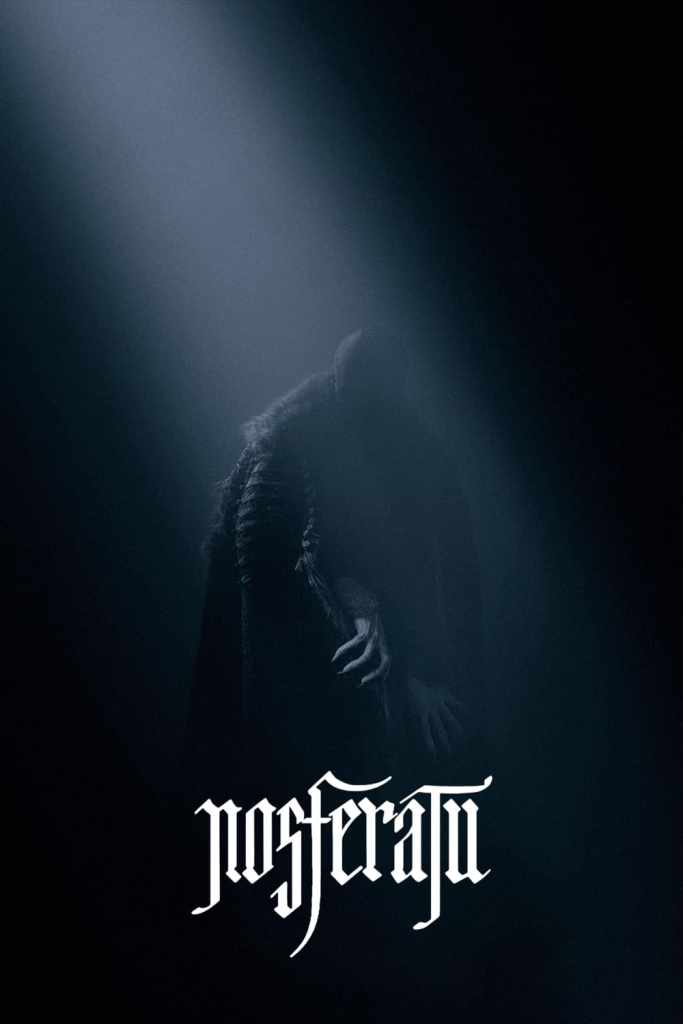
A gothic tale of obsession between a haunted young woman and the terrifying vampire infatuated with her, causing untold horror in its wake.
The anticipation for this release has been high from the moment it was announced.
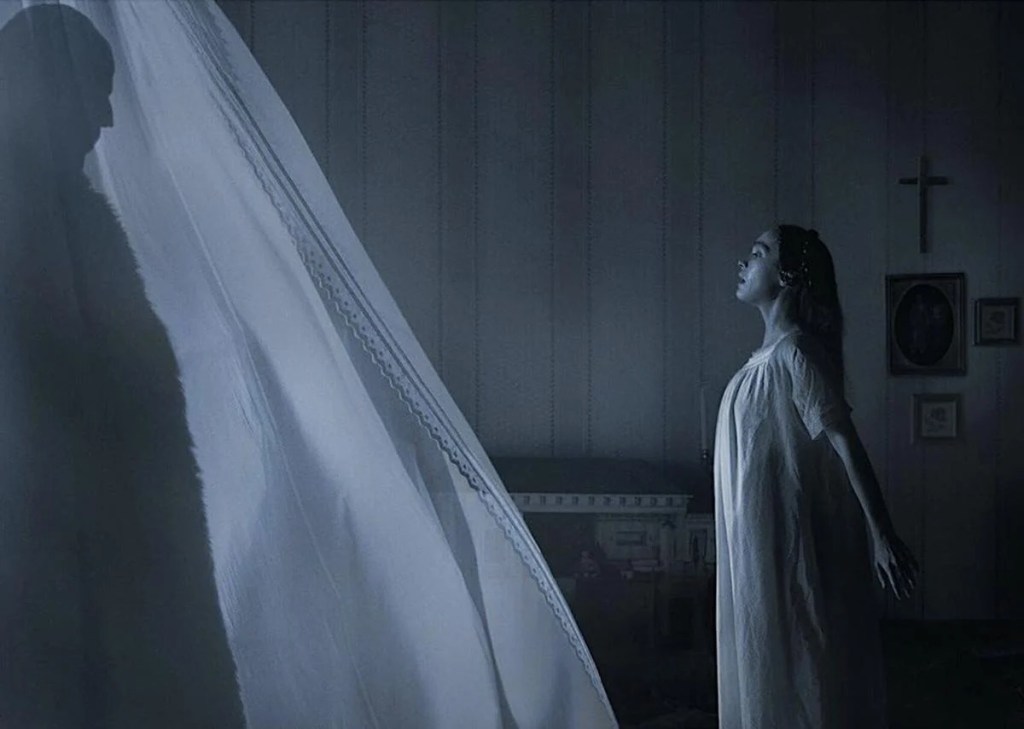
I feel I should warn people who haven’t yet been to see it. This is a Robert Eggers film, that means that this is going to be a divisive feature, especially if you go into it without knowing what his usual style is so I advise that you prepare yourself before you watch it.
This is a tale that I think was ripe for a remake, which is not something I’d usually say, and even though the original film is over 120 years old it;s still a truly iconic piece of film making but this was a great way of reintroducing this story to a new generation (just like the ’79 version did for a lot of people).
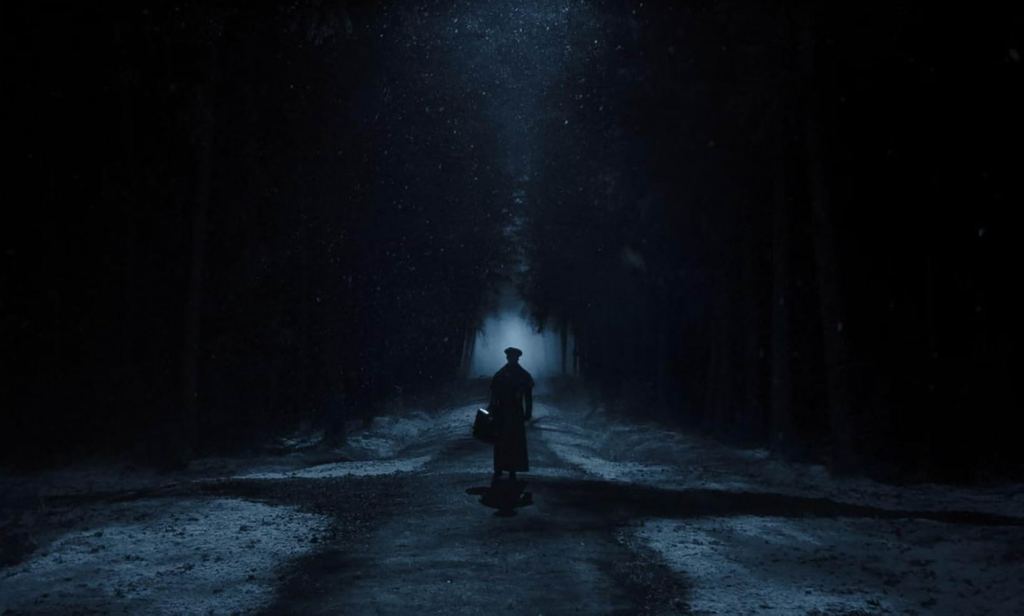
As I said before, director Robert Eggors is a divisive figure but after watching it I was glad that it was Eggers who took it on. His visual style truly elevates this film to a whole new level, it’s such a beautiful film to watch and each scene is like a painting.
The cast is also great and the acting is simply superb. Though that’s not to say there isn’t some things I didn’t like, such as why if the film is set in Germany does everyone talk with an English accent? But that’s just something that annoys me in films and shows in general.
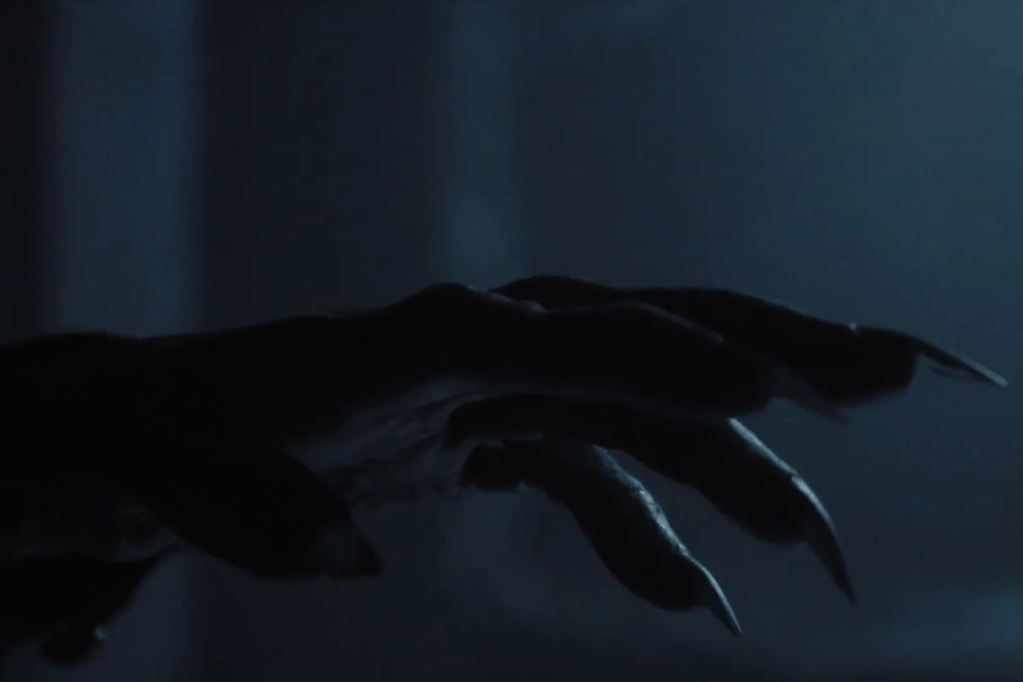
Simply put, “Nosferatu” is as near-perfect a gothic masterpiece as you’re going to get. But like I said, it’s certainly not going to be for everyone.
If you want to see the “Nosferatu” trailer then just click on the video below:
Miscellaneous facts about the film:
The exteriors of Orlok’s castle were filmed at Hunedoara Castle, also known as Corvin Castle, a Romanian castle located in Transylvania and one of the largest medieval castles extant in Europe. What’s more, it’s the castle where Vlad Dracula was briefly imprisoned.
According to Bill Skarsgård, his voice was the aspect of the part he worked hardest at, spending six weeks before shooting not doing “much else than just record myself.” “And on set, I would keep doing these exercises. It sounds kind of like Mongolian throat-singing. It’s insane.”
Bill Skarsgård trained with an opera coach to lower his voice an octave to make the voice of Count Orlok as deep as possible.
The word Nosferatu is of uncertain origin. It’s believed that Bram Stoker first learned it from an 1885 article by Emily Gerard on Transylvanian superstition, and the only previous usage is from a German article on vampires from 1865 by Wilhelm Schmidt. Both sources claim the word is Romanian, but the term has no meaning in that language.
To get the film’s eerie moonlit look for the night scenes, the crew filmed the scenes during the day time and in post production ran it through a computer to remove the red and yellow color spectra.
Willem Dafoe did a scene with 2,000 live rats.
The castle scenes were filmed in the Pernstejn Castle in the Czech Republic, the same location that was used for Werner Herzog’s film Nosferatu the Vampyre (1979).
In an interview with Variety, director Robert Eggers explained that the design for Orlok deliberately went back to folklore and to the culture of Orlok’s home region. “So, to try to make a more scary vampire than we’ve had in quite some time, I went back to the folklore. It’s something that I like anyway, but the early folk vampire was written about by people who believed that vampires existed. There was going to be some good stuff there, and the vampires of folklore is a putrid, walking undead corpse. And so, the question became, ‘What does a dead Transylvanian nobleman look like? That means this complex Hungarian costume with very long sleeves, strange high-heeled shoes and a furry hat. It also means a mustache. No matter what, there’s no way this guy can’t have a mustache. Try to find a Transylvanian person who’s of age who can grow a mustache that doesn’t have a mustache. It’s part of the culture. If you don’t want to bother Googling, think of Vlad the Impaler. Even Bram Stoker had the sense to give Dracula mustache in the book.”
The preparation for his role as Count Orlok was reportedly so intense, that Bill Skarsgård stated that it is the one role where he’s ever truly terrified himself. In an interview with director Robert Eggers, Skarsgård said, “I’ve never been more terrified of a role and probably won’t be again. The whole journey was so intense. Once you start channeling something that’s not you, you feel like a vessel.” After filming, he stated that he would “never play a role as evil as this one again.”
Director Robert Eggers revealed that Lily-Rose Depp brought him to tears during her audition. Eggers explained, “I had a meeting with Lily and she just impressed me so much. She understood the script so well, she had seen every major Dracula adaptation and a lot of more obscure ones, she immediately brought up our Polish friend director friend Andrzej Zulawski and I knew we were on the same page. But then we did an audition, a screen test, and it was just as raw and powerful as what she’s doing on screen. I’m not exaggerating; I was in tears because her audition was so insane. And she’s just such a disciplined, courageous, and like, feral actor. She’s amazing.”
Bill Skarsgård was originally cast as Thomas Hutter. However, during the film’s long pre-production, director Robert Eggers decided to recast Skarsgård as Count Orlok/Nosferatu instead. In an interview with Skarsgård, Eggers stated that he felt that the recasting was to make the sexual subtext between Orlok and some of his victims even more convincing.
An extended cut of the film will include footage of Orlok that was glimpsed in the film’s trailer, but not the theatrical version. The scene is Orlok as seen from the back. “It’s one of those annoying things for film dorks because it’s not in the movie,” director Robert Eggers said of the shot. “It’s a really cool shot, really liked the shot, but where it was intended, it was ruining some tension to know that [Orlok] was around.” He added, “We needed to keep him more mysterious. But if you would wish to purchase the Blu-ray, it is in the extended version of the film.”
Robert Eggers co-directed a stage production of Nosferatu in high school.
Producer Chris Columbus said Bill Skarsgård was so terrifying in costume that he couldn’t even approach him on the set. That is until Skarsgård made everyone laugh. Then Columbus “knew Nosferatu had a sense of humor.”
Director Robert Eggers has previously spoken about how Bill Skarsgård transformed for the role. “I’ll say that Bill has so transformed, I’m fearful that he might not get the credit he deserves because he just…he’s not there,” Eggers said. “He felt like honoring who had come before him. It’s all very subtle. But I think the main thing is that he’s even more a folk vampire. In my opinion he looks like a dead Transylvanian nobleman, and in a way that we’ve never actually seen what an actual dead Transylvanian nobleman would look like and be dressed like.”
Bill Skarsgård was concerned about the way his character, Count Orlok, was looking while undergoing hours of makeup and prosthetic application. Skarsgård was also worried that he wouldn’t be able to properly perform while wearing the layers of makeup and prosthetics. In an interview with Entertainment Weekly, he states, “I was worried that I couldn’t perform through it, that it would feel like giant prosthetic pieces, and I couldn’t come alive through that.” Skarsgård goes on to say, “There was definitely a stage when they hadn’t put everything on, where I was like, ‘I look like the fucking Grinch or a fucking goblin.’ I did not like at all how it was translating.” However, the makeup process had proven to be effective and the actor was able to immerse himself in the role.
In regards to some of the physically demanding sequences in which her character, Ellen Hutter, becomes psychologically tormented by Orlok, Lily-Rose Depp, Depp notes, “As far as the physical stuff, Rob introduced me to Japanese butoh, which is a Japanese performance art dance form, which at the core of is this idea of letting your consciousness and yourself kind of float away from your physical body. You become an empty vessel for something else to take over.”
The original 1922 film was almost lost. Bram Stoker was the creator and author of the novel “Dracula” in 1897. His widow took legal action against F. W. Murnau, the director of Nosferatu: A Symphony of Horror (1922), due to the similarities to Dracula. The judge ordered all copies of the 1922 film to be destroyed, but thankfully some survived, or this remake might never have been made.
Bill Skarsgård as Count Orlok/Nosferatu was purposefully kept mostly hidden in the trailers and promotional materials (i.e. a set of six individual movie posters of the main characters only show Professor Albin Eberhart Von Franz, Ellen Hutter, Thomas Hutter, Anna Harding, and Friedrich Harding while the upper halves of their faces are covered in shadow as their eyes glow, yet Count Orlok is hidden in almost pitch-black shadow). It wasn’t until a few weeks before the film’s release that the unveiling of Skarsgård in makeup as the Count in some articles about the film that most people finally saw what the actor looked like as the character.
Director Robert Eggers credits SpongeBob SquarePants (1999) for introducing the character of Nosferatu to younger generations. In the season two, episode 16a, and the 36th episode, Graveyard Shift/Krusty Love (2002), SpongeBob and Squidward are left in charge overnight at the Krusty Krab. Squidward tells SpongeBob about the story of the Hash Slinging Slasher which momentarily scared SpongeBob. In the middle of the episode, the lights periodically start flickering on and off, and SpongeBob and Squidward become creeped out. At the end of the episode, someone holding his own spatula shows up to the Krusty Krab, whom SpongeBob and Squidward mistake for the Hash Slinging Slasher, asking for a job application. The three then discover that the continuously flickering lights are due to Nosferatu (which is the shot of the famous doorway scene in Nosferatu: A Symphony of Horror (1922) except for a light switch on the wall and the character flickering it) flickering the light switch. They lightly admonish him while pointing at him and smirking. Nosferatu then smiles sheepishly as the episode ends. After the episode’s airing, Nosferatu’s popularity and renewed interest flourished.
Ellen’s cat, whom she says “has no master nor mistress”, is named Greta, after Ellen Hutter’s original actress, Greta Schröder. Also, Ellen owned a cat in Nosferatu: A Symphony of Horror (1922).
Lily-Rose Depp worked with a movement coach for the physicality and ferocity side of Ellen Hutter. Depp states, “I also worked [with a] movement coach who was incredibly helpful, and we kind of mapped out all those movements and then tried to infuse them with an emotion that felt true. They were more than just physical movements, but also infused with a real pain and a real kind of insight into what kind of internal battle she was going through.”
This is the second Nosferatu-related film that Willem Dafoe, who plays Professor Albin Eberhart Von Franz in this film, stars in. The first film is Shadow of the Vampire (2000) in which Dafoe portrays a fictionalized vampiric Max Schreck. Shadow of the Vampire (2000) is a quasi-remake of, a semi-biopic, and fictional behind-the-scenes look at Nosferatu: A Symphony of Horror (1922).
Orlok’s entrance into the Hutter home, with his shadow crossing the walls, mirrors the iconic shot from Nosferatu: A Symphony of Horror (1922) of Orlok ascending the stairs.
As with on the sets of It (2017) and It: Chapter Two (2019), despite portraying a villainous character in this film, Bill Skarsgård made sure that he didn’t purposefully frighten his fellow co-stars and crew members while not filming and joked around with them.
Harry Styles and Anya Taylor-Joy were originally cast in the lead roles. Styles dropped out due to “scheduling conflicts”, and the project was delayed, which resulted in Taylor-Joy also dropping out later, as she was filming Furiosa: A Mad Max Saga (2024) at the time. Lily-Rose Depp took over Taylor-Joy’s role.
Flowers often carry symbolism. Purple lilacs are handled and mentioned throughout the movie on significant moments: the specific variants with a lighter shade of purple are traditionally associated with one’s first love or the first time one feels love for someone, an important theme in the movie.
The film’s budget was about $50,000,000.
Filming started in Prague, Czechia, in March 2023 at the historic landmark known as “Invalidovna.” Filming wrapped on May 29, 2023.
The name “Orlok” was likely derived from the Dutch word “oorlog” (itself pronounced remotely as “orlok”) which means “war.”
While the 2024 Count Orlok’s stupendous mustache and fur-lined cloak are unique to him, his silhouette and shadow are identical to those in the original Murnau film.
The film was partially filmed at Rozmitál Castle, located in Rozmitál pod Tremsínem, Prague, Czech Republic.
Willem Dafoe plays Professor Von Franz – an academic from Switzerland who was excommunicated for studying the occult and alchemy. C.G. Jung left his position at the University of Zurich in 1913 in part due to his studies of occultism and alchemy. One of his most prominent students – Marie-Louise von Franz – a psychologist from Switzerland – is well-known for her studies in fairy-tales and alchemy. Dafoe and von Franz also share a similar hair cut in the film.
This is the third collaboration between director Robert Eggers and Ralph Ineson. The first two are The Witch (2015) and The Northman (2022).
In Nosferatu: A Symphony of Horror (1922), Max Schreck, who portrayed Count Orlok, only blinks once in the entire performance. Although not listed as an homage to that film, in the night-time scene where Lily-Rose Depp, who portrays Ellen Hutter, walks to the window, she doesn’t blink once during a single lengthy shot.
The film was released 102 years after the original 1922 film Nosferatu: A Symphony of Horror (1922).
Nicholas Hoult also starred in another loose adaptation of Dracula, Renfield (2023).
Bill Skarsgård is no stranger to enduring hours in the makeup chair to embody terrifying, otherworldly creatures. Skårsgard’s transformation into Pennywise in It (2017) required two to five hours of prosthetic application, and in the sequel, It: Chapter Two (2019), the prosthetic application was reduced to two and a half hours. For this film, the process was even more demanding, varying between four and six hours depending on the extent of the look.
Bill Skarsgård, who portrayed Count Orlok in this film, is the youngest actor to portray the vampire nobleman, at age 32 at the time of filming. Gary Oldman, who portrayed Count Dracula in Dracula (1992), is the second-youngest actor to portray the Count, at age 33. Both Oldman and Skårsgard were 34 when their respective films were officially released.
As with Willem Dafoe who wanted to work with director Robert Eggers after seeing The Witch (2015) which led to their first collaboration with The Lighthouse (2019), Bill Skarsgård wanted to work with Eggers after seeing and enjoying The Witch (2015). Sometime after this film began its early development and after The Witch (2015)’s release, Skarsgård eventually met Eggers, they got along extremely well, and the director cast him in the film.
Makeup effects designer David White explained the meticulous process of designing Bill Skarsgård’s prosthetics to embody the ageless yet decayed Count Orlok. White drew inspiration from Max Schreck’s Nosferatu: A Symphony of Horror (1922) portrayal of the vampire while crafting a wholly original vision for director Robert Eggers’ remake. The designer revealed the most challenging part of the design. “I would say the most challenging part to develop was the fact that his prosthetic makeup had to work on so many levels, and with only one sculptural look. I had to find interesting ways to meet all the criteria. I was keen to keep his age ambiguous [and] ageless, so to speak. I did this by being very particular about the amount of wrinkles and obvious character lines, keeping the look more sparse with no hoods over his eyelids and no eye bags,” White states.
This is the second time that Bill Skarsgård portrayed a vampire. The first time is in the Netflix show, Hemlock Grove (2013).
Director Robert Eggers envisioned a Count Orlok with an aristocratic air. As make-up effects designer David White explained, “Orlok was of noble stature, [so] Robert really wanted him to have a mustache and forelock,” a distinct departure from the original version, which was nearly hairless except for some bushy and expressive eyebrows.
One of two Nosferatu: A Symphony of Horror (1922) remakes released in 2024, along with Nosferatu (2023). This other film was funded on Kickstarter in 2014 and took ten years to get a release.
This is the third collaboration between director Robert Eggers and Willem Dafoe. The first two are The Lighthouse (2019) and The Northman (2022), respectively.
In this film, Ellen Hutter’s husband is named Thomas Hutter. In Nosferatu: A Symphony of Horror (1922), he is simply referred to as Hutter, and she is referred to as Ellen. For different English versions of the film, the characters had different names. In some versions, he is referred to as “Thomas”, and in other versions, he is referred to as “Jonathan”. Likewise, in some versions, his wife is referred to as “Ellen”, and in other versions, she is referred to as “Mina”. The names Jonathan and Mina are references to the main characters of Bram Stoker’s novel, the same novel that inspired Nosferatu: A Symphony of Horror (1922).
All of Count Orlok’s teeth are sharp, with the top central and lateral incisors being longest.
According to makeup artist David White, Bill Skarsgård, as Count Orlok, wore nine prosthetics for his head and face alone. These include the neck, the back of the head, chin, cheeks, bottom and top lip, ears, nose, forehead, and nose bridge. Facial hair such as mustache and hair pieces were added as well. Skårsgard was also fitted with top and bottom hand prosthetics with eight finger extensions incorporating nails and two thumbs which were each applied with a blender prosthetic to disguise the edges.
This film was first announced in 2015.
The fictional German city where the Hutters live is named Wisborg. This is likely a nod to the original Nosferatu: A Symphony of Horror (1922) filming locations, Wismar and Lübeck.
Professor Albin Eberhart Von Franz shares his first name with Albin Grau, the producer, production designer, and occultist who worked with Murnau on Nosferatu: A Symphony of Horror (1922).
Nicholas Hoult almost got attacked by wolves while shooting the film. “I’m, like, running on the spot and getting hyped up before the take,” Hoult said. “And they’re being held back from me on leashes – barking, like, with death in their eyes. They want to eat.”
Bill Skarsgård, who portrays Count Orlok in this film, is 6’4. Max Schreck, who portrayed the character in Nosferatu: A Symphony of Horror (1922), was 6’3, an inch shorter than Skarsgård.
Bill Skarsgård, who portrays Count Orlok in this film, is from Sweden. The original film, Nosferatu: A Symphony of Horror (1922), was banned in Sweden from 1922 to 1972 due to its excessive horror.
With the exception of The Lighthouse, Ralph Ineson has appeared in all of Robert Eggers’s feature films. With the exception of The VVitch, Willem Dafoe has appeared in all of Eggers’s films as well.
The film is director Robert Eggers’ first remake.
The film was originally projected to open at $25 million. The film opened at over $40 million, impressing box office projectionists.
This is Bill Skarsgård’s fourth horror film. The first three films that follow are It (2017), It: Chapter Two (2019), and Barbarian (2022), respectively.
Robert Eggers’ first film not to have “The” in the title.
Robert Eggers cites Milan Fras, the lead singer of Eastern European band Laibach, as part inspiration for the look and voice of Count Orlock.
 Raz's Midnight Macabre